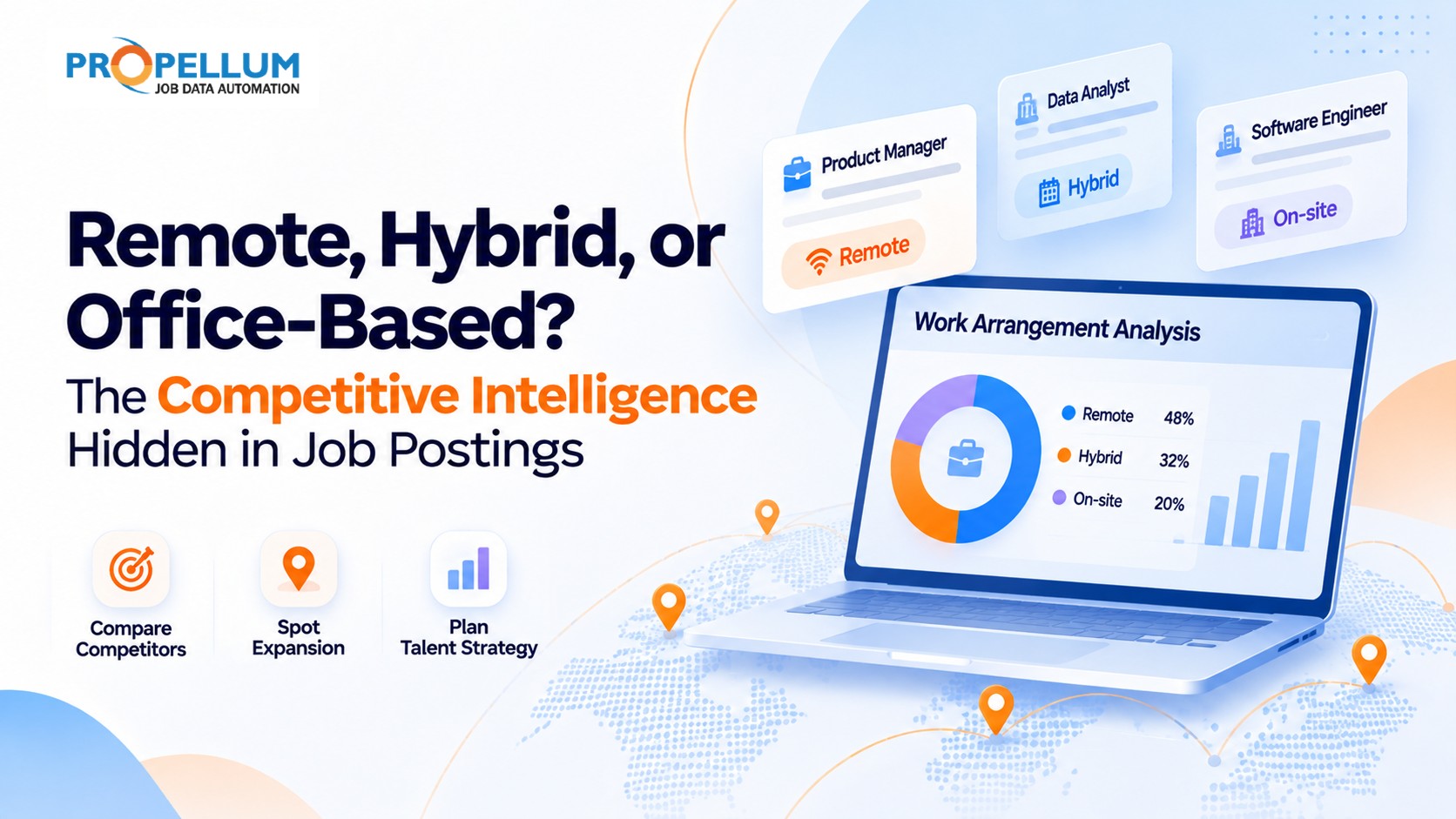
A company advertises remote engineering roles across multiple countries. Its closest competitor concentrates hybrid vacancies around a handful of cities. Another continues to recruit predominantly for office-based positions.
These differences may seem like ordinary workplace policies. But viewed across hundreds or thousands of job postings, they can reveal something more significant: where companies are willing to search for talent, where they concentrate their teams, and which functions still depend on physical presence.
The distribution of remote, hybrid, and office-based vacancies provides an additional lens through which businesses can examine their competitors. It can help answer questions about geographic reach, workforce organization, talent accessibility, and potentially changing operational priorities.
Workplace arrangements are not just employment benefits. When examined across companies and over time, they become useful signals for competitive intelligence.
1. Three Workplace Metrics. Three Different Business Signals.
The value comes from looking at the distribution of remote, hybrid, and office-based postings together, rather than treating each listing in isolation.
Remote hiring: How widely is the company accessing talent?
A higher share of remote vacancies may indicate that a company is willing to recruit beyond the immediate geography of its offices.
This can reveal:
- A broader geographic talent strategy.
- Access to specialist talent that may be difficult to source locally.
- A distributed workforce model.
- Potential competition for employees across different regional markets.
For example, a software company advertising remote engineering roles across several countries may be competing for talent in markets where it has no major office presence. For a competitor analyst, this provides a useful signal of the company’s potential talent reach. One important distinction: remote does not automatically mean work-from-anywhere. A vacancy may still be restricted to a particular country, region, or time zone.
Hybrid hiring: Where does the company appear to anchor its workforce?
Hybrid positions often connect location flexibility with an expectation of physical workplace access. A company with a high proportion of hybrid vacancies concentrated in a few cities may indicate that those locations play an important role in its operating structure.
This can reveal:
- Important workforce hubs.
- Locations where collaboration or management functions are concentrated.
- Regional talent markets the company continues to prioritize.
- Differences in workplace strategy between business units.
For example, a competitor hiring hybrid product managers and engineering leaders in Bengaluru while recruiting remote sales employees across India may be organizing different functions around different geographic requirements. That distinction can help analysts understand where the company is building organizational concentration.
Office-based hiring: Where does physical presence matter?
A high proportion of office-based vacancies can indicate that certain operations depend on physical workplaces, specialized infrastructure, customer proximity, or in-person collaboration. This is particularly relevant in industries such as manufacturing, healthcare, financial services, retail, and engineering.
The geographic distribution matters just as much as the percentage. A company consistently recruiting office-based employees in a new city may be signalling increased operational activity in that market. A cluster of such vacancies could justify closer examination of its regional priorities.
It does not automatically prove that a new office or facility is opening. However, it provides an early indicator worth investigating alongside other business evidence.
2. The Competitive Intelligence Value Emerges When Companies Are Compared
Looking at one company provides context. Comparing several competitors provides intelligence.
Consider this hypothetical comparison:
| Metric | Competitor A | Competitor B |
| Remote postings | 60% | 15% |
| Hybrid postings | 30% | 35% |
| Office-based postings | 10% | 50% |
Both companies operate in the same industry and recruit for similar professional roles.
What could this difference indicate?
Competitor A appears more willing to access talent across wider geographies. This may give it access to a larger candidate pool, although its actual reach depends on location restrictions and hiring practices.
Competitor B appears more dependent on physical workplace access. This could reflect its operating requirements, organizational structure, or preference for location-based teams.
For a competitor analyst, the next question is not simply which company has more remote jobs. It is whether these arrangements create differences in talent access, employer positioning, geographic concentration, or operating requirements.
Research published by the National Bureau of Economic Research, examining more than 500 million vacancy postings across five English-speaking countries, found that remote-work availability varied substantially across companies, industries, occupations, and locations. Differences were also evident between employers competing in the same industry for similar occupations.
This is particularly important: workplace arrangements can differentiate direct competitors even when they recruit for comparable roles.
Source: NBER, Remote Work across Jobs, Companies, and Space.
3. Five Business Applications of Workplace Intelligence
The remote, hybrid, and office-based distribution becomes useful when connected to specific business decisions.
1. Competitor talent strategy – HR strategy and corporate intelligence teams can benchmark workplace arrangements across competing employers. A competitor increasing remote hiring in a specialist function may be broadening its talent access and changing how it competes for experienced professionals.
2. Geographic expansion research – Market intelligence teams can examine where competitors advertise hybrid and office-based opportunities. A growing concentration of location-dependent roles in a new market may indicate increasing operational importance. This can help prioritize markets for further investigation before a company makes a public expansion announcement.
3. Sales and account intelligence – Workplace arrangements can provide contextual signals for B2B sales teams.
For example, a company with a growing distributed workforce may have different collaboration, endpoint management, identity security, and infrastructure requirements from an organization with predominantly office-based operations.
Technology vendors can use these differences to improve account research and identify relevant business conversations. These are potential needs, not proof of purchasing intent.
4. Investment and business research – Investors and research teams can examine workplace arrangements alongside hiring volumes, roles, locations, and company announcements.
A distributed hiring model, a growing concentration of office-based vacancies, or a shift towards hybrid recruitment may contribute to understanding how a business is organizing its workforce.
These signals should inform further investigation rather than serve as standalone evidence of financial performance or management strategy.
5. Employer positioning and talent competition – Companies can assess how their advertised flexibility compares with direct competitors for similar roles. Gallup’s research on US employees with remote-capable jobs reported that 52% worked hybrid, 26% exclusively remote, and 22% on-site in May 2026. Its research also found that six in ten remote-capable employees preferred hybrid arrangements.
These employee survey findings are not equivalent to job-posting statistics. However, they illustrate why workplace flexibility can matter when evaluating an employer’s position in the talent market.
Source: Gallup Hybrid Work Indicator.
4. What Companies Should Be Careful About
Workplace data is useful, but interpreting it without context can produce misleading conclusions. A company hiring predominantly office-based engineers may have a very different reason for doing so than a company recruiting office-based retail or manufacturing staff.
Comparisons should therefore account for:
- Industry: Workplace requirements differ substantially between sectors.
- Occupation: Remote suitability varies between engineering, sales, manufacturing, and customer-facing roles.
- Geography: Remote eligibility and hybrid expectations may differ by country and region.
- Time: A single snapshot cannot establish a sustained change in company strategy.
- Data coverage: Some employers do not explicitly state workplace arrangements, so missing information should not be mistaken for an office-based requirement.
Most importantly, job postings reveal advertised workplace expectations, not actual employee attendance, office occupancy, or the company’s complete workplace policy.
The strongest conclusions emerge when these signals are compared with other evidence, such as company announcements, office locations, hiring volumes, and financial disclosures.
5. From Workplace Data to Competitive Intelligence
Workplace arrangements are often treated as recruitment information. But when examined across companies and over time, they can contribute to a much broader understanding of business behaviour. This is the larger opportunity in job data intelligence.
Propellum provides job data infrastructure that helps organizations work with structured employer job postings across companies, industries, and geographies. For businesses building competitive intelligence, market research, and workforce analytics products, workplace arrangements represent another dimension through which employer activity can be examined.
The insight is not that remote work is better than hybrid or office-based work. It is that where companies choose to recruit tells us something about how they choose to compete. And that makes these three seemingly ordinary metrics worth paying attention to.
Frequently Asked Questions
They can help analysts understand a company’s geographic talent reach, distributed workforce strategy, and potential competition for specialist employees beyond its immediate office locations.
Hybrid vacancies can provide signals about important workforce hubs, location preferences, and the geographic concentration of certain business functions.
Not necessarily. However, a growing concentration of office-based vacancies in a new market can be an indicator of increased operational activity that deserves further investigation.
Comparing all three provides a more complete picture of workplace strategy and can reveal differences in talent access, geographic priorities, and operating requirements.
Yes. It can add context to account research by indicating whether an organization is expanding distributed teams, concentrating employees around physical locations, or changing its workforce model. It should be treated as a potential business-need signal, not confirmed buying intent.
Job postings represent advertised vacancies and stated workplace arrangements. They do not establish actual employee attendance, total workforce distribution, office occupancy, or confirmed business expansion. They should be interpreted alongside other sources of evidence.