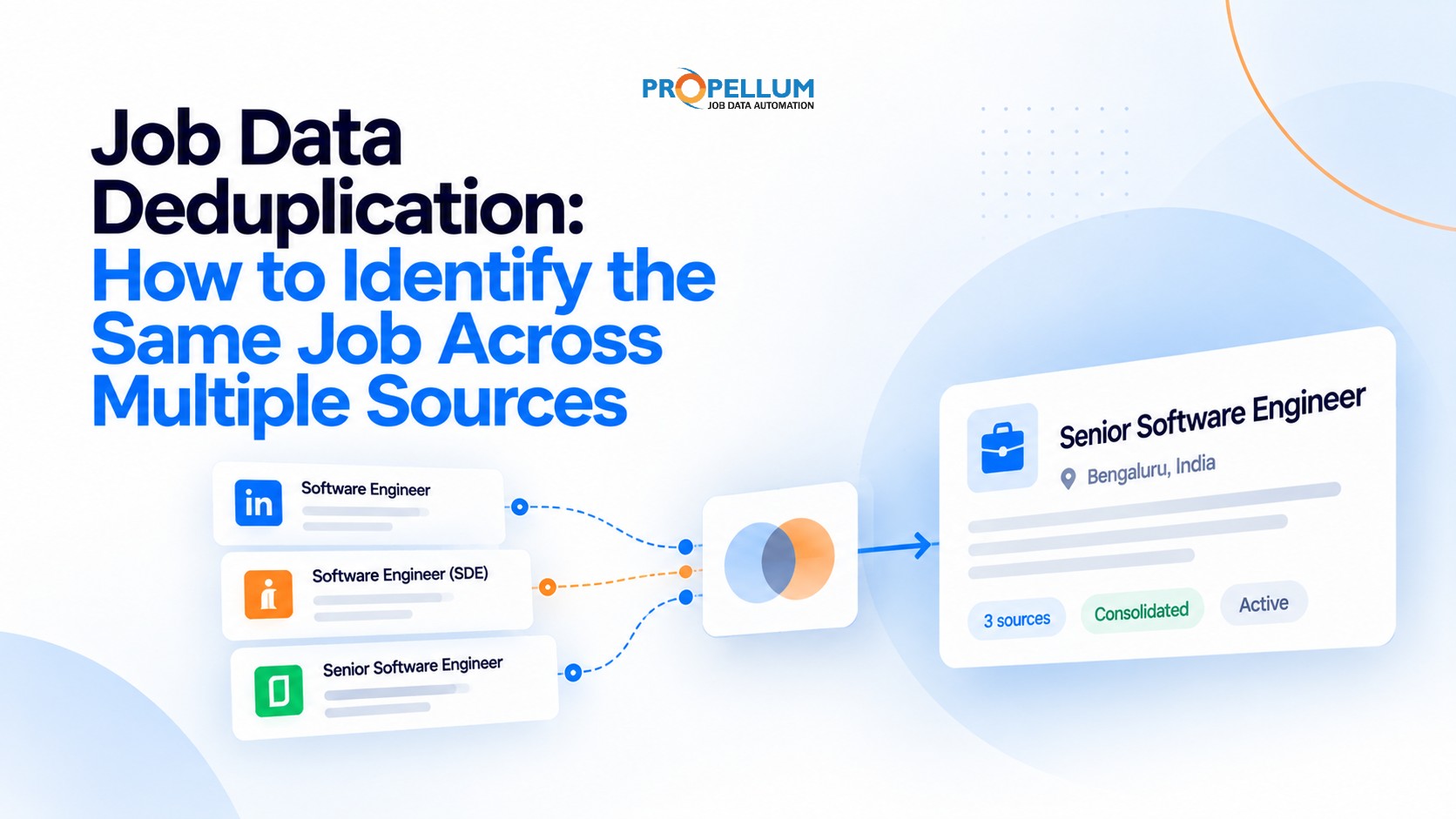
The same job vacancy can appear on an employer’s career page, an applicant tracking system (ATS), a recruitment platform, and multiple job boards. Each source may represent the opening differently, using a different URL, title format, description structure, or company name. For a job board or recruitment technology platform aggregating these sources, this creates a data problem. Counting every record as a separate vacancy inflates listing volume, creates a poor candidate experience, and distorts downstream hiring analytics.
Job data deduplication is the process of identifying records that represent the same underlying vacancy and consolidating or suppressing redundant listings. The technical challenge is determining which records genuinely refer to the same job, even when their fields differ. A reliable solution combines data normalization, candidate matching, similarity scoring, and carefully controlled duplicate resolution.
1. Start by Normalizing Job Records
Before comparing two listings, a system needs to make their data comparable.
Consider these records:
| Field | Record A | Record B |
| Job title | Senior Software Engineer | Sr. Software Engineer |
| Company | ABC Technologies Pvt. Ltd. | ABC Technologies |
| Location | Mumbai, Maharashtra | Mumbai, India |
| Job URL | /careers/role-123 | /jobs/98421 |
These records may describe the same vacancy, but a simple text comparison would identify several differences.
Normalization reduces differences that are merely formatting variations. Typical operations include:
- Titles: Standardize capitalization, whitespace, abbreviations, and known title variants.
- Company names: Resolve common aliases, legal suffixes, and brand variations to a consistent employer identity.
- Locations: Map city, region, and country values to a common geographic representation.
- URLs: Remove tracking parameters and normalize equivalent URL formats where safe.
- Descriptions: Strip HTML, navigation text, repeated boilerplate, and irrelevant formatting.
Importantly, normalization should preserve the original values alongside standardized fields. A title such as “Senior Software Engineer” and “Engineering Manager” must not become equivalent simply because both contain similar words.
2. Generate Candidate Matches Before Comparing Every Record
Comparing every job against every other job becomes expensive as a dataset grows. With (n) records, exhaustive pairwise comparison requires (n(n-1)/2) comparisons. For one million records, that is approximately 500 billion pairs. Production pipelines therefore use blocking, also called candidate generation, to reduce the search space.
A system might group records using combinations of:
- Employer identity and normalized title
- Employer identity and geographic location
- Source job ID or canonical application URL
- Similar titles within the same employer and time window
Only records that share one or more plausible matching characteristics proceed to detailed comparison. Blocking rules need to balance efficiency with recall. If they are too restrictive, genuine duplicates will never reach the matching stage. For example, blocking exclusively on exact job titles would miss “Software Developer” versus “Software Engineer” even when both describe the same opening.
3. Use Multiple Signals to Score Similarity
Once candidate pairs have been generated, the system evaluates whether they represent the same vacancy. A robust matching process examines multiple fields rather than relying on one identifier.
| Matching signal | What it helps establish |
| Employer identity | Whether both records belong to the same organization |
| Job title | Whether the roles are equivalent or closely related |
| Location | Whether the openings share the same geographic scope |
| Job description | Whether responsibilities and requirements substantially overlap |
| Application URL or job ID | Whether records point to the same underlying vacancy |
| Posting dates | Whether the records appeared within a plausible time window |
The system can calculate field-level similarity using different methods:
- Exact matching: Compares stable identifiers, such as a source job ID, when their uniqueness and reliability are established.
- Fuzzy string matching: Uses techniques such as edit distance or token similarity to accommodate spelling differences, abbreviations, and reordered words.
- Semantic similarity: Uses text embeddings to compare the meaning of titles or descriptions, helping identify records that use different wording for similar content.
A weighted scoring model can combine these signals:
[
S = w_eE + w_tT + w_lL + w_dD + w_uU
]
Here, (E), (T), (L), (D), and (U) represent employer, title, location, description, and URL or identifier similarity. The weights (w) determine each signal’s contribution.
This is an illustrative model, not a universal formula. Weights and decision thresholds must be calibrated against representative, labeled job records.
4. Combine Rules, Machine Learning, and AI Carefully
No single matching technique works equally well across every source. Rule-based matching is fast and explainable. It works particularly well when reliable identifiers exist. However, it struggles with missing fields and substantial differences in wording.
Machine learning classifiers can learn from labeled pairs of duplicate and non-duplicate listings. Features may include string similarity, semantic similarity, employer identity, geographic distance, and temporal proximity. Embedding-based matching can retrieve semantically similar records, while a language model can help adjudicate ambiguous cases by examining the actual role, location, and responsibilities.
Recent research on job-posting deduplication has explored a pipeline combining embedding-based candidate filtering with language-model validation. This supports a hybrid approach, although performance still depends on data quality, thresholds, and evaluation methodology. Read the research.
A practical system can use three decision outcomes:
- High confidence: Automatically merge or suppress the duplicate.
- Intermediate confidence: Apply additional checks or send the pair for review.
- Low confidence: Retain both records as separate vacancies.
AI should support the matching decision, not automatically override conflicting evidence.
5. Resolve Duplicates Without Losing Valuable Information
Identifying a duplicate pair is only half the problem. The system must decide what happens next. A canonical job record can represent the underlying vacancy while retaining source-level information about each observed listing.
For example, one source may contain a complete description, while another provides a more recent application URL. A careless deduplication process could discard useful information or preserve an outdated listing.
A better resolution process should:
- Select a canonical record using defined quality and freshness rules.
- Consolidate compatible fields from duplicate records.
- Preserve source URLs, source identifiers, and provenance.
- Track when the vacancy was first and last observed.
- Revisit the record when source data changes or the job expires.
This distinction is especially important for historical analysis. A job disappearing from one source does not necessarily mean the vacancy has closed. The underlying opening may still be active elsewhere.
6. Measure Deduplication Quality
A deduplication system should be evaluated against a manually verified sample of matching and non-matching record pairs. Three useful metrics are:
- Precision: Of all pairs classified as duplicates, how many really were duplicates?
- Recall: Of all genuine duplicate pairs, how many did the system identify?
- False-positive rate: How often did the system incorrectly classify distinct vacancies as duplicates?
Precision matters because merging separate vacancies can remove legitimate inventory. Recall matters because missed duplicates inflate counts and create repeated listings. Evaluation should also cover difficult cases, including multi-location roles, recurring vacancies, reposted jobs, employer aliases, missing identifiers, and substantially rewritten descriptions.
The right threshold depends on the use case. A consumer-facing job board may prioritize avoiding false merges, while a large-scale analytical dataset may require a different balance between precision and recall.
How Propellum Approaches Job Data Deduplication
Deduplication is one component of a broader job data infrastructure pipeline. Propellum processes job listings through collection, parsing, normalization, enrichment, validation, and duplicate handling before delivering structured data to downstream platforms.
This matters because matching quality depends on more than the algorithm itself. Consistent employer identities, normalized titles, structured locations, source provenance, and reliable job-status information all improve the evidence available to a deduplication system.
For job boards, aggregators, and AI applications, the objective is not simply to remove repeated records. It is to maintain a dependable representation of each vacancy while preserving the information needed for search, matching, reporting, and historical analysis.
Learn more about Propellum’s job data enrichment capabilities or its job data infrastructure for job boards and aggregators.
Conclusion
Job data deduplication is fundamentally an entity-resolution problem: determining whether different records refer to the same real-world vacancy.
Reliable implementations combine normalization, efficient candidate generation, field-level and semantic matching, calibrated decision thresholds, and careful record resolution. They also measure false merges and missed duplicates rather than judging success solely by how many records are removed.
As job data moves across more sources and downstream applications, deduplication becomes a foundational part of data quality. The goal is a dataset that represents vacancies accurately, without inflating inventory or losing meaningful distinctions.
Frequently Asked Questions
Job data deduplication identifies multiple records that represent the same underlying job vacancy and consolidates or suppresses redundant listings.
Common approaches include exact identifier matching, fuzzy string matching, record-linkage models, machine learning classifiers, text embeddings, and language-model-assisted validation.
A system can compare employer identity, title similarity, location, description semantics, application URLs, identifiers, and posting dates. No single field should determine the result in every case.
Normalization standardizes how data is represented. Deduplication determines whether separate records represent the same entity. Normalization often improves deduplication accuracy, but it does not replace matching.
Overly aggressive matching can merge separate vacancies, including similar roles at the same employer or openings in different locations. This can reduce listing coverage and distort analytics.
Propellum incorporates duplicate handling into its job data processing pipeline, alongside crawling, parsing, normalization, enrichment, and validation, to deliver structured job data to downstream platforms.