When companies hire for artificial intelligence, the first roles that come to mind are usually machine learning engineers, data scientists, and AI researchers.
But the employment market is telling a broader story.
AI-related requirements are beginning to appear in familiar occupations across marketing, finance, manufacturing, administration, education and professional services. Companies are not only recruiting people to build AI systems. They are increasingly looking for people who can apply these capabilities within existing business functions.
This distinction matters. Counting newly created AI jobs captures only one part of the workforce transition. Examining how skills and responsibilities change within existing occupations reveals another.
A closer look at job posting data from the United States, Europe, and emerging economies helps explain how this shift is taking shape.
1. AI Is Changing the Job Title Landscape
One of the clearest signals of this transition is the appearance of AI in job titles that traditionally had little connection to artificial intelligence.
An Indeed Hiring Lab analysis published in July 2026 tracked standardised job titles across the United States and five European markets.
Its findings show that the spread is not limited to technology occupations. AI-related titles now appear across sales, human resources, customer service, legal services, administration, teaching and skilled trades.
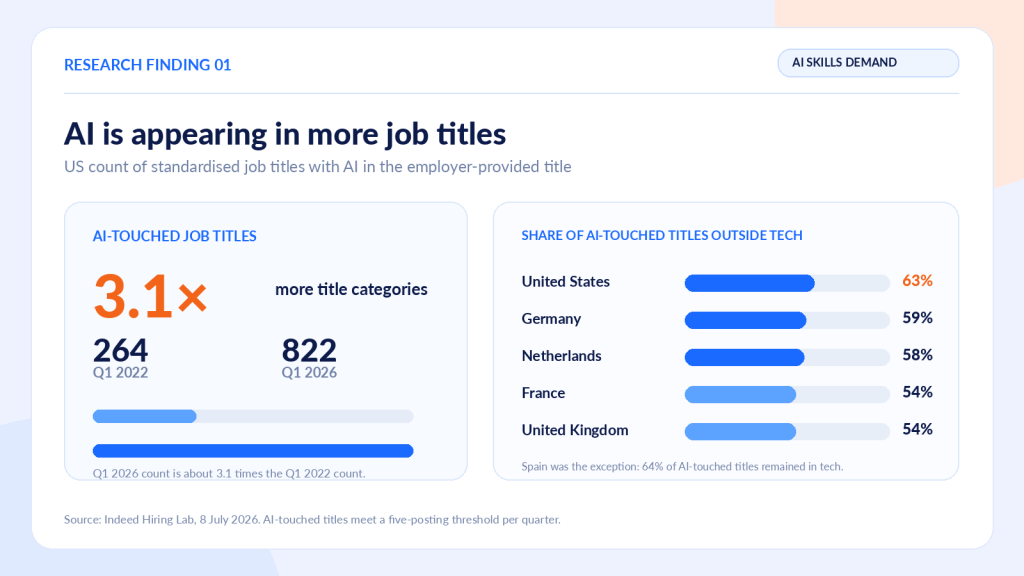
The important insight is the widening range of occupations employers are associating with AI.
A conventional sales role, for example, may increasingly involve AI-assisted research, lead qualification or customer engagement. An HR position may include AI-supported workforce analysis or recruitment processes. A teaching role may involve AI-enabled learning tools.
The underlying occupation may remain familiar, but the capabilities expected from the person performing it can change.
There is an important distinction in this research: Indeed counted a standardised title as AI-touched only when at least five postings in a quarter included AI in the employer-provided title. This makes the finding a signal of established role categories, rather than an isolated mention of AI. It does not measure every job that requires AI skills.
2. Traditional Industries Are Developing New AI Skill Requirements
Changes in job titles are only one signal. Another appears within the skills employers specify in job descriptions.
Stanford University’s AI Index Report 2026 examined the share of vacancies mentioning AI skills across 15 US economic sectors.
The findings show that the movement extends well beyond the information and technology sector.
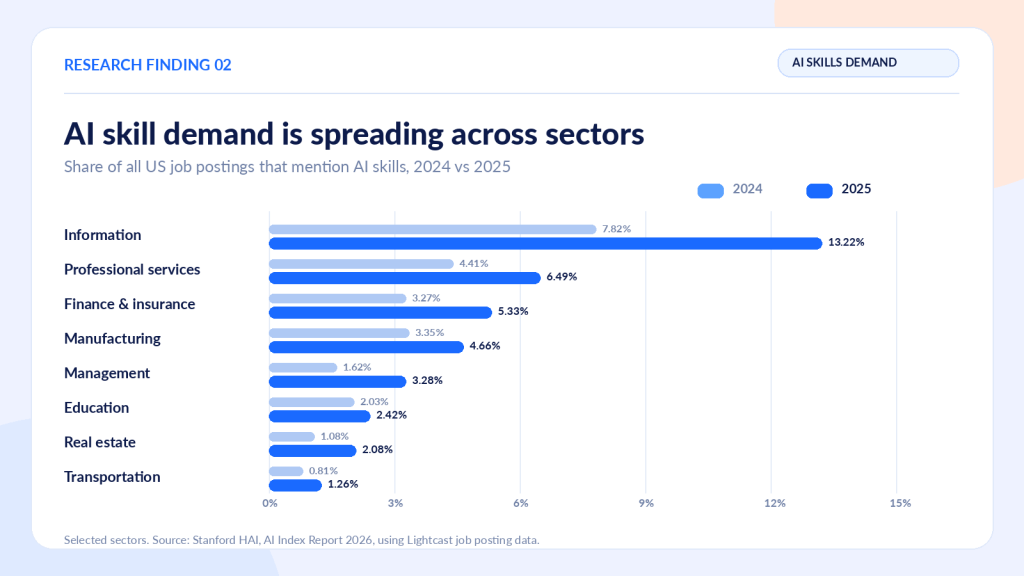
Consider what this means for traditional industries.
In manufacturing, AI capabilities may be relevant to production planning, predictive maintenance, and quality control. In finance, they may support risk analysis, forecasting and automated workflows. In real estate, they may relate to market analysis, property valuation and customer operations.
These examples illustrate potential applications, not proof that employers have deployed these systems.
What the hiring data establishes is that AI-related capabilities are becoming more visible in the requirements attached to jobs across different sectors.
For investment researchers, this creates an additional dimension of analysis. Tracking AI-related hiring only among technology companies could miss changes taking place inside established businesses and industries.
3. AI Hiring Growth and Market Concentration Tell Different Stories
The geography of AI-related hiring is equally interesting.
A World Bank Digital Progress and Trends Report 2025 examined online vacancy trends across countries with different income classifications.
It found that AI-skill vacancy growth was faster in middle-income economies over the period studied, although most AI-related vacancies remained concentrated in high-income markets.
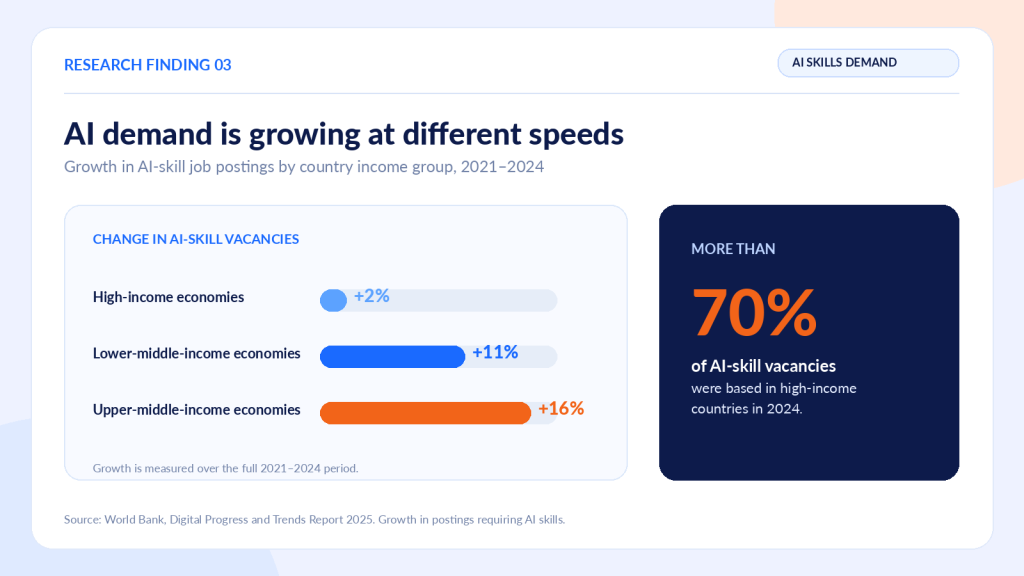
This distinction is important for anyone comparing countries or evaluating technology-related investment opportunities.
A market experiencing rapid growth does not necessarily have the largest volume of AI opportunities. Growth rates can be influenced by the starting level of demand, economic conditions, and the coverage of online vacancy data.
The World Bank also found that AI skills were still required in only a small share of global online vacancies during the period studied. GenAI-specific vacancies increased ninefold between 2021 and 2024, yet represented just 0.2% of online postings in 2024.
This adds useful perspective to the AI hiring narrative. Rapid growth in a specialist category does not automatically mean that it represents a large proportion of the total employment market.
For market intelligence teams, both measures matter: the rate at which demand is expanding and the concentration of that demand across countries.
4. AI Literacy Is Moving Into Everyday Professional Roles
The transition is not limited to specialist AI knowledge.
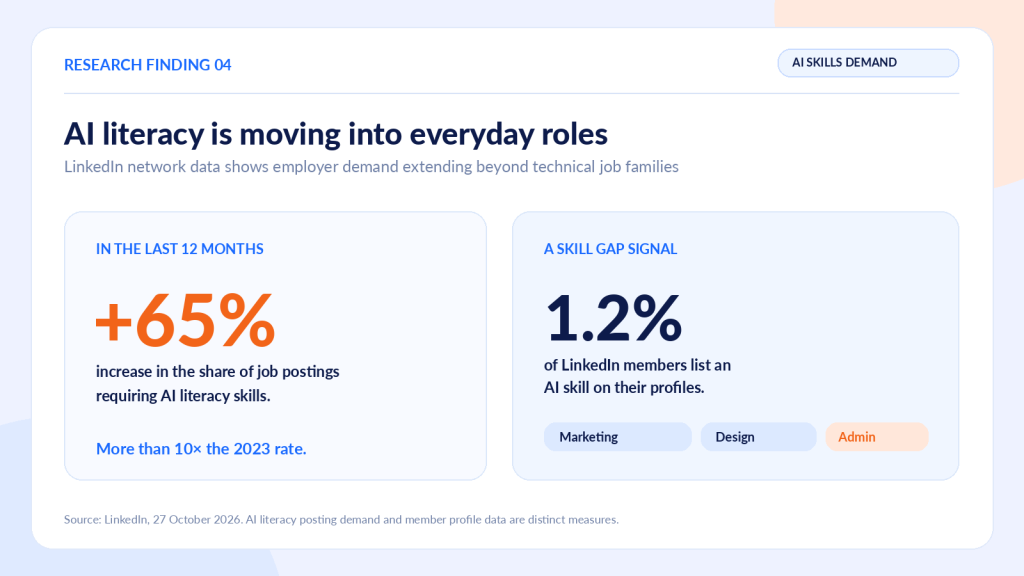
LinkedIn’s October 2026 research found a substantial increase in job postings requiring AI literacy skills. Its data also highlighted demand for these capabilities in marketing, design, project management, administration and writing.
This points to a different kind of workforce change.
AI engineering requires specialised technical expertise. AI literacy, however, can involve understanding how to use AI tools, evaluate their outputs, and apply them responsibly within a professional role.
The distinction matters because a company does not necessarily need to create a new AI department to introduce AI-related requirements into its workforce.
A marketing manager, business analyst, or administrative professional may remain in the same occupational category while the skills expected of that position evolve.
LinkedIn also reported that only a small proportion of its members explicitly listed an AI skill on their profiles. This should not be directly compared with job posting requirements, since the two measures come from different populations. It does, however, highlight why employer demand and declared workforce skills are useful complementary research perspectives.
5. What These Changes Mean for Job Market and Investment Research
Taken together, the findings point to a more complex AI employment transition than simply counting AI-related vacancies. There are at least three developments worth monitoring:
New occupational categories: Employers are defining new roles around AI development, implementation, training, and business enablement.
Changing skill requirements: Existing occupations are incorporating AI-related capabilities without necessarily changing their titles.
Uneven geographic and industry demand: The pace and concentration of AI-related hiring differ across markets and sectors.
For alternative data providers and investment research teams, these developments create several measurable research questions:
- Which industries are incorporating AI-related skills into their vacancies?
- Are employers recruiting dedicated AI specialists or adding AI requirements to existing occupations?
- Which countries are experiencing faster growth in AI-related hiring?
- How is the mix of AI, machine learning, GenAI, and agentic AI skills changing?
- Which employers and sectors are showing sustained changes in their advertised skill requirements?
Answering these questions requires more than keyword counts. Job titles, employer information, industry classification, location, skills, and posting dates need to be examined together.
It is also important to distinguish advertised demand from actual adoption. A vacancy mentioning AI does not independently prove that the employer has deployed the technology, achieved productivity improvements or completed a particular investment.
6. The Role of Structured Job Data in Tracking AI Skills Demand
Understanding these changes over time requires job data that can be analysed consistently across companies, industries and countries.
Propellum provides structured job data through APIs, feeds and custom data solutions. Its Job Records API, Skills Intelligence Feed and Historical Job Dataset can support analysis of job titles, employer requirements, skills, industries, locations and hiring patterns.
For alternative data providers, institutional investors and research organisations, this information can provide an additional view of how employer demand is evolving.
Combining current and historical job posting data can help researchers distinguish short-term fluctuations from more sustained changes in occupational and skill requirements.
The value lies not simply in identifying more AI-related vacancies, but in understanding where AI capabilities are appearing, which occupations they affect, and how employer expectations evolve.
Conclusion: The AI Workforce Transition Is Bigger Than AI Jobs
The spread of artificial intelligence across the labour market cannot be understood by tracking AI-specialist hiring alone.
The more significant story may be how AI-related capabilities are becoming part of roles that already exist across industries, business functions and geographic markets.
For researchers and data-driven businesses, this makes job posting data an increasingly useful source of workforce intelligence. It provides observable signals of changing employer requirements, new occupational categories, and the growing relevance of AI skills.
The next phase of AI hiring research is not just about counting AI jobs. It is about understanding how AI is changing the jobs we already have.
Frequently Asked Questions
AI skills demand refers to the capabilities employers request in job vacancies that relate to artificial intelligence, machine learning, generative AI, AI literacy, and related technologies.
Job posting data can reveal where employers are requesting AI-related skills, which occupations include those requirements, and how demand changes over time. It indicates advertised workforce requirements, not confirmed technology adoption.
It can provide signals about changing workforce requirements, industry-level technology demand, geographic differences, and the development of specialised capabilities. These insights can complement financial, operational, and other alternative data sources.