Knowing which skills employers are looking for sounds straightforward. Count how often a skill appears in job postings, compare it with previous periods, and identify what is gaining demand. But the reality is more complicated.
A skill that appears frequently in job descriptions is not necessarily the most important skill for an occupation. The same skill can mean different things across industries, employers may describe similar capabilities differently, and job advertisements do not always reflect everything an employee needs to perform a role.
For businesses using job posting data to understand workforce trends, these distinctions matter. A misleading interpretation of skills demand can influence hiring strategies, workforce planning, investment decisions, and education programmes.
The challenge is not simply identifying which skills appear in the market. It is understanding what those appearances actually represent.
1. The Same Skill Can Mean Different Things Across Industries
Skills do not exist independently of the work they support.
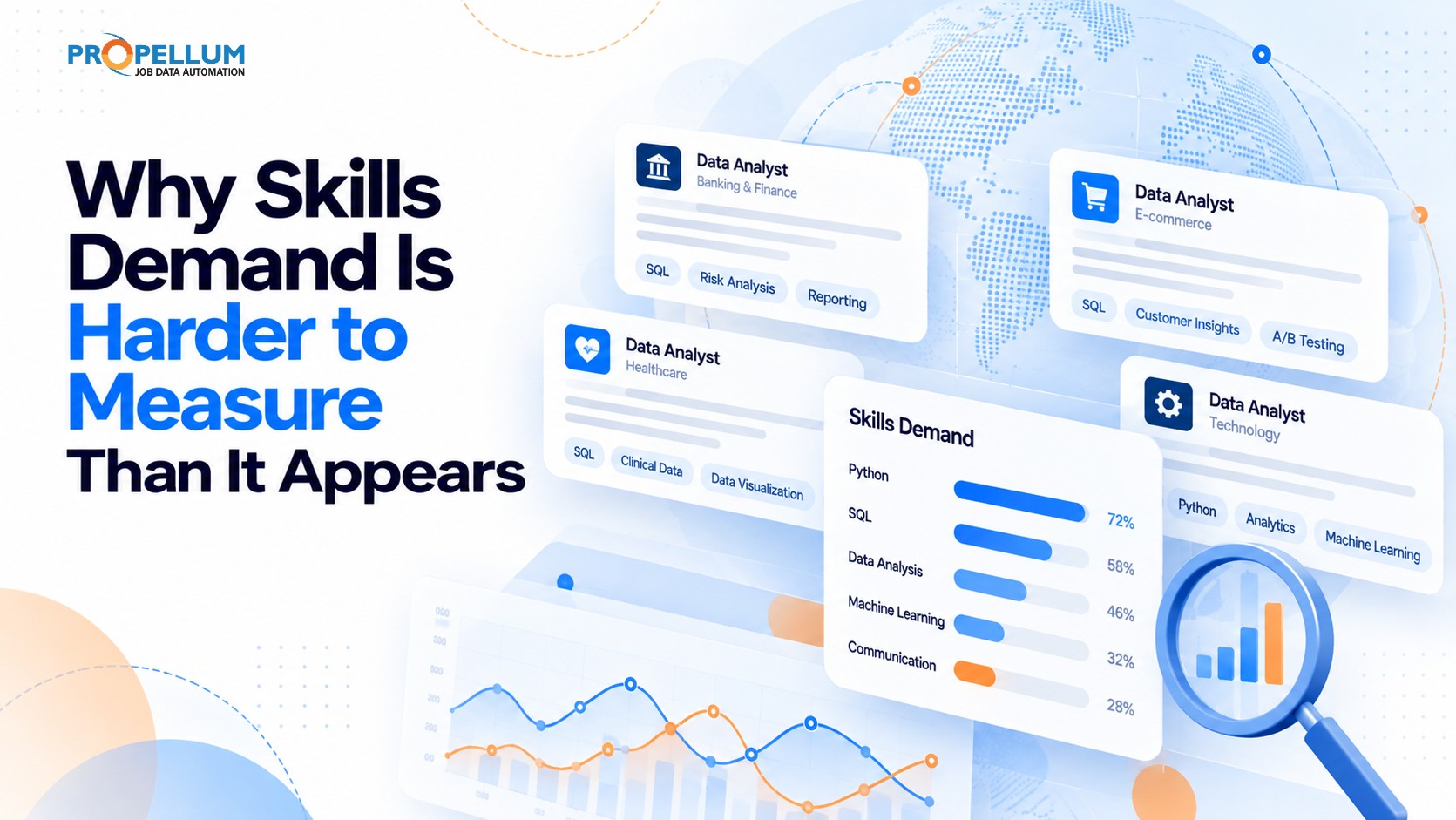
Consider data analysis. A financial services company may associate it with financial modelling, risk assessment, and regulatory reporting. A healthcare organization may need data analysis for clinical research, patient outcomes, or operational performance. A technology company may connect it with product analytics, experimentation, and customer behaviour.
The skill label remains the same, but the professional context changes. This creates a problem when comparing skills demand across industries. Treating every mention as an identical requirement can hide important differences in how employers apply a capability.
The same issue appears across occupations. Python, for example, may be central to a machine learning engineer’s responsibilities but simply one of several useful tools for a business analyst. A market-level view may show that Python is widely requested. It does not automatically explain where the skill matters most or what employers expect someone to do with it.
2. Employers Do Not Describe Skills Consistently
There is no universal way for employers to communicate skill requirements.
One organization may request machine learning experience. Another may ask for predictive modelling, statistical learning, or familiarity with ML frameworks. These descriptions can overlap without being completely interchangeable. The problem also works in reverse. Two employers may use the same terminology while expecting different levels of proficiency or entirely different applications.
The OECD’s 2026 research on a skills-first labor market highlights how fragmented skill definitions and inconsistent terminology make it difficult to compare information across employers, education systems, and labor market datasets. This is not just a data presentation issue. Inconsistent language can affect how organizations understand emerging capabilities, identify skills gaps, and compare demand across markets.
Without sufficient context, apparently similar skills may be grouped together even when they represent different capabilities.
3. Advertised Requirements Are Not the Same as Skills Used at Work
A job description communicates what an employer wants from a potential employee. It does not provide a complete account of every capability that the person will use after joining. Some requirements are emphasized because they are difficult to find. Others are included because they are desirable rather than essential. Certain skills may be so fundamental to an occupation that employers do not explicitly mention them.
For example, a job advertisement for a software engineer may emphasize cloud platforms, programming languages, and security expertise. However, communication, problem-solving, documentation, and collaboration may also occupy a significant part of the actual role. The European Commission’s Joint Research Centre has highlighted that online job advertisements can understate certain skills because employers consider them self-evident. Its research also notes that employers may not always describe their requirements accurately. Read the research.
This distinction becomes particularly important when skills data is used for education and workforce development. A course catalogue aligned with frequently advertised requirements may still miss capabilities that employees need in practice. Similarly, an employer’s advertised skill preferences should not automatically be interpreted as a complete description of the job.
4. Frequency Does Not Always Reflect Importance
One of the easiest mistakes in skills demand analysis is assuming that the most frequently mentioned skills are the most important.
Imagine two capabilities:
- Skill A appears in 40% of relevant job postings.
- Skill B appears in 12% of relevant job postings.
Skill A clearly has broader observed presence within that dataset. But does that make it more important?
Not necessarily.
Skill A might be a widely expected foundational capability. Skill B might be a specialized requirement that is essential for a smaller group of high-value roles.
The difference is important for several audiences.
For an education provider, broad demand may indicate an opportunity to serve a large learner population. For a specialist training company, a less frequently requested skill may represent a more focused area of expertise. For workforce planners, the importance of a capability depends on the roles in which it appears and the business activities those roles support.
A frequency ranking provides one perspective. It should not be mistaken for a ranking of economic importance, proficiency requirements, or business criticality.
5. Online Job Postings Do Not Represent the Entire Labor Market
Another challenge comes from the source of the information itself. Not every vacancy is advertised online. Hiring practices differ across industries, occupations, company sizes, and geographies. The OECD has highlighted that online vacancy datasets can underrepresent areas such as agriculture, construction, and some elementary occupations. Smaller businesses may also be less likely to advertise vacancies online.
This creates a coverage bias. For example, a dataset dominated by technology companies and professional services firms may provide a detailed picture of digital skills demand. It may provide a much weaker picture of skills requirements in sectors where recruitment relies more heavily on informal networks or other hiring channels.
The European Commission’s research similarly identifies differences in the representation of occupational groups within online job advertisements. <a href=”https://www.oecd.org/en/publications/assessing-and-anticipating-skills-for-the-green-transition_28fa0bb5-en/full-report/component-8.html“>OECD research on skills measurement</a> discusses these limitations.
Therefore, an increase in the visibility of a skill within online postings should not automatically be treated as proof that demand is increasing across the entire economy. It may reflect a genuine change in employer requirements, a change in which employers are advertising online, or both.
6. Skills Demand Is Constantly Changing
Skills are not static categories. Technology adoption, industry transformation, regulation, and changing business models all influence the capabilities employers seek. Artificial intelligence provides a clear example. As organizations introduce AI into their operations, existing roles may acquire new responsibilities, while entirely new combinations of capabilities become relevant.
However, the appearance of a new term in job descriptions does not necessarily mean a new occupation or skill has emerged. Sometimes employers simply begin using new terminology for existing capabilities. In other cases, the underlying work genuinely changes.
This makes historical context important. A skill appearing more frequently over several comparable periods may indicate a sustained shift in employer expectations. A temporary increase may reflect a short-lived recruitment cycle or a narrow concentration of hiring activity. The distinction matters to education providers deciding which courses to develop, employers planning future workforce capabilities, and researchers studying changes in the labor market.
7. Why Better Skills Intelligence Matters
These challenges have implications beyond recruitment.
- For education providers, skills intelligence can help assess whether course offerings remain relevant to employer requirements.
- For workforce planning teams, it can provide an external perspective on capabilities gaining importance within particular industries and occupations.
- For market researchers, it can help identify how skill requirements differ between companies, sectors, and geographical markets.
- For HR technology platforms, it can provide a richer context for understanding role requirements and changing talent needs.
The underlying requirement is dependable job data that provides sufficient context for meaningful comparisons.
This is where Propellum’s job data infrastructure becomes relevant. Propellum provides structured job data and skills intelligence capabilities built around employer job postings, supporting organizations that develop workforce analytics, labor market research, and skills intelligence products.
The objective is not simply to identify popular skills. It is to provide a stronger foundation for understanding where employer requirements are changing and what those changes may mean.
Conclusion
Skills demand is harder to measure than it initially appears because the information reflects multiple realities. Skill terminology varies. Job descriptions do not capture every capability used at work. Frequently mentioned skills are not necessarily the most important, and online job postings do not represent every part of the labor market equally.
These limitations do not make job posting data less valuable. They make interpretation more important. For organizations studying workforce trends, the real value of skills intelligence lies in understanding the context behind employer requirements, not simply counting how often a skill appears. The question is no longer just which skills employers are asking for. It is where those skills matter, what they mean, and how their importance is changing.
Frequently Asked Questions
Skills demand refers to the capabilities and competencies employers seek when recruiting for jobs. It can be examined across occupations, industries, locations, and time periods.
Employers use inconsistent terminology, job descriptions do not capture every skill used at work, and frequently mentioned capabilities are not necessarily the most important. Online postings also represent an incomplete view of the labor market.
They provide evidence of employer-stated requirements, but they are not a complete inventory of skills used by employees. Some capabilities may be omitted, while others may be desirable rather than essential.
Skills demand describes the capabilities employers need. Skills supply describes the capabilities available among workers. Comparing the two can help identify potential skills shortages and mismatches.
Historical job posting data can reveal changes in employer requirements and emerging patterns. However, these signals should be interpreted alongside industry developments, workforce trends, and other relevant evidence.
Propellum provides job data infrastructure and structured employer job posting data that organizations can use to develop skills intelligence, workforce analytics, and labor market research products.